Water Systems Analysis Group
Riverine ecosystem services and the thermoelectric sector: Strategic issues facing the Northeast. [PDF].
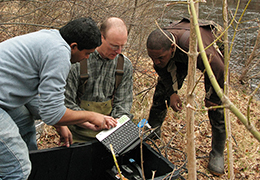
WSAG researchers look at newly downloaded data from the Lamprey River deployment site near Packer's Falls in Lee, NH. [full story].
Research
Aquatic Biogeochemistry
- Nitrogen and carbon cycling in aquatic environments
- Global biogeochemistry of nutrients and carbon
- Controls of nutrient flux and attenuation in river networks
- Development of continental scale aquatic ecosystem models
Arctic and the Cryosphere
- The effect of climate change on the polar ice sheets
- River ice responses to a warming Arctic
- Interactions between land cover/use change and hydrology
- Pan-Arctic and global-scale hydrometeorological modeling
Macro-Hydrology Resources
- Ecosystem services in suburban and agricultural New England landscapes
- Characterization of hydrology-related ecosystem services
- Feedbacks among biogeochemistry, hydrology, and human activities through time
- Biogeochemical and hydrological responses to urbanization and climate change
Banner image: Saco River Estuary (photo courtesy of Joe Dube at http://joedube.com).